
When the jaw can no longer hold a standard implant
A traditional dental implant relies on one thing above all else: healthy jawbone. The titanium post needs enough height and width to anchor into, so it can fuse with the bone over three to six months. When that bone isn’t there — after long-term denture wear, advanced periodontitis, trauma, or previous tumour surgery — conventional implants simply cannot be placed.
Until fairly recently, the only path forward was bone grafting: harvesting bone from the hip, skull, or tibia and slowly rebuilding the jaw. It works, but it’s invasive, unpredictable in older patients, and adds roughly a year to the treatment timeline. For many patients, that’s simply too long — or medically off the table.
The zygomatic bone: an anchor nature gave us
The zygomatic bone — commonly known as the cheekbone — is one of the densest bones in the face and is virtually never affected by the atrophy that destroys the upper jaw. Zygomatic implants take advantage of this. Instead of anchoring into the depleted upper jaw, they pass through it and anchor deep into the cheekbone itself.
The result: a single, immediate anchor strong enough to support a full-arch bridge — no bone graft required. The technique was first pioneered by Swedish surgeon Per-Ingvar Brånemark, and after three decades of refinement it has become a reliable, well-documented option.
“Patients arrive with a denture they’ve hated for years and leave, the same day, with fixed teeth that feel like their own. It remains one of the most rewarding procedures in modern dentistry.”
How the procedure actually works
A typical zygomatic implant case follows a defined sequence:
- 1Comprehensive 3D CBCT planningEvery angle of the zygomatic bone and nearby sinus cavity is digitally mapped. We simulate implant placement before surgery to avoid any unpleasant surprises.
- 2Surgery under sedation or general anaesthesiaMost cases take 2–4 hours. Two to four zygomatic implants are placed alongside two conventional implants in the front of the jaw.
- 3Immediate temporary teethA fixed temporary bridge is attached on the same day. You walk out with a full set of teeth you can smile with.
- 4Healing & final prosthesisAfter 3–6 months of healing, the temporary bridge is swapped for a custom-designed permanent prosthesis matched to your facial aesthetics.
Who is a candidate?
Zygomatic implants are specifically designed for patients who have been told traditional implants aren’t an option. Typical candidates include:
- Long-term denture wearers with significant upper-jaw bone resorption
- Patients who previously failed bone-grafting procedures
- Patients who have lost bone following tumour resection or trauma
- People who want a fixed solution without waiting a year for grafts to heal
That said, zygomatic implants are not for everyone. Active sinus infections, uncontrolled diabetes, and certain rare bone conditions may preclude the procedure. This is why every case at Esthetica begins with an in-person consultation and a detailed CBCT scan.
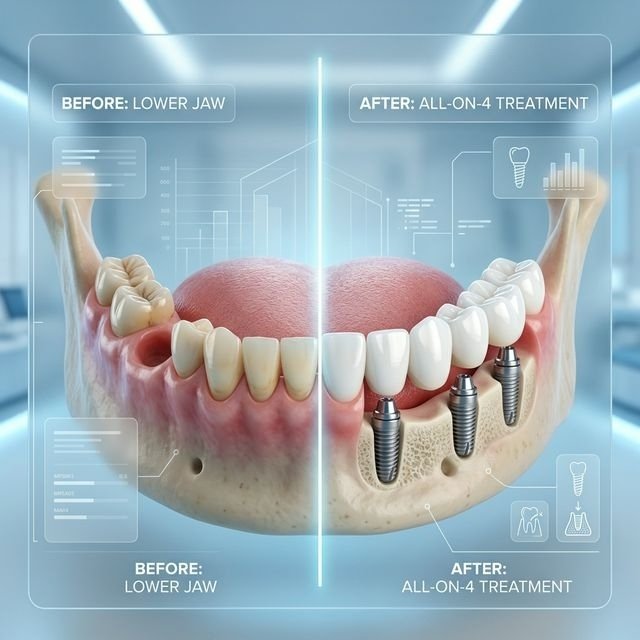
Zygomatic vs All-on-4
All-on-4 works when at least moderate bone remains in the front of the jaw. Zygomatic implants are reserved for cases where conventional All-on-4 is not viable because of extreme bone loss. Your treating surgeon will recommend whichever protocol your anatomy actually supports.
Recovery and what to expect
Recovery after zygomatic implant surgery is comparable to — and sometimes easier than — traditional full-arch implant surgery, mainly because there is no bone-graft donor site to heal. Typical recovery looks like this:
- Days 1–3: Mild swelling and bruising around the cheek and under-eye area; manageable with prescribed medication.
- Week 1: Soft diet only — smoothies, soups, scrambled eggs. Most patients return to desk work.
- Weeks 2–4: Gradual return to normal eating with the temporary bridge.
- Month 3–6: Final permanent prosthesis fitted; long-term follow-up begins.
Cost considerations
Zygomatic implant treatment is more specialised than conventional implant surgery and is priced accordingly. That said, when you compare it against the total cost of a full year of bone-grafting plus subsequent traditional implants, the numbers are often similar — and the time savings are enormous.
At Esthetica, we provide a transparent, written quote after your CBCT scan, and 0% EMI financing is available. Full details are on our implant pricing page.
Success rates and longevity
Multiple long-term studies report zygomatic implant survival rates above 95% at 10 years — numbers comparable to conventional implants in healthy bone. With diligent oral hygiene and regular follow-up, the implants themselves can last a lifetime. The prosthetic bridge on top is typically replaced every 15–20 years due to wear, not implant failure.
Key Takeaways
- Zygomatic implants offer a fixed-teeth solution when the upper jaw has severe bone loss — no grafting required.
- Most patients walk out with a fixed temporary bridge the same day as surgery.
- Long-term survival rates exceed 95% at 10 years in published literature.
- The procedure requires a specialist oral-maxillofacial surgeon and a thorough 3D CBCT work-up — never choose on price alone.